
Category: Blog

  • Foundations of a Great Financial Life

    Foundations of a Great Financial Life

    A study conducted by the Australian Stock Exchange reported that nearly 25% of investors over the past two years were aged 18 to 24. 

    These young Australians were found to be knowledge seekers, keen to take on life and begin their journey towards financial security.

    If this describes you, congratulations! You get it, you really do. You’re Next Generation Investors who know that building financial independence starts early.

    However, according to the same study, Next Generation Investors, aware of their inexperience, are uncomfortable making financial decisions. 

    If this is also you, here are our tips for laying the foundations for a wealthy future!


    Avoid Unnecessary Debt

    If there’s one thing guaranteed to keep you awake at night it’s debt. Naturally, some debt can’t be avoided and is considered ‘good’ debt, like when you borrow to buy a house.

    But ‘bad’ debt is sometimes unnecessary and often comes with high interest; best avoided where possible. You know we’re talking about credit cards, right?

    Credit cards can fast-track you into debt-strife, particularly as tap-and-go transactions are just so quick and so easy.

    Additionally, while those buy-now-pay-later schemes can be useful for emergencies if, say, your fridge packs up, they’re a trap if you don’t stay in control.

    Sure, online shopping and bill-paying means using cards but you can avoid using credit. 

    Functioning the same as credit cards, debit cards use your money instead of the bank’s. They can be linked to your bank account, or loaded with cash which is handy for keeping track of your spending, as you can only spend as much as you’ve loaded.

    If you do end up with debt, be accountable. Pretending it’s not there won’t make it go away. Further, unpaid bills can grow through late fees and penalties.

    Read the fine print on contracts and understand what you’ve signed up for. Late payments and loan defaults can result in legal action, even bankruptcy, destroying your credit rating for years!

    Pay down debt as soon as you can by:

    • making additional payments where possible.
    • paying above the minimum monthly amount.
    • consolidating debts, and negotiating a better deal.
    • prioritising debts with the highest interest rate.

    Track Spending

    On the topic of spending, get into the habit of tracking yours. Using a simple spreadsheet, or an app from your bank, log your purchases and reconcile spending with receipts.

    You’ll see exactly where your money is going and spot any areas of unnecessary spending, like those items you really don’t need but are the coolest ‘must-haves’. 

    Don’t fall for it; ‘must-have’ is a marketing term. True must-haves are basics like food, shelter, transport and medical – not the latest trends and gadgets.

    We’re not saying don’t treat yourself occasionally, but to pause and consider whether the item is really worth burdening yourself.

    Superannuation

    Think you’re too young to worry about superannuation? Prefer to put your money toward something for now rather than later?

    You may be right, but don’t dismiss super altogether. Here are some things you can do that won’t impact your current finances:

    • Ensure your employer is contributing the correct amount of super. If you are earning more than $450, pre-tax in any calendar month, your employer must contribute 10% to a super fund on your behalf. These contributions are Superannuation Guarantee Contributions (SGC) and they are compulsory.
    • Low-income earners may qualify for Government Co-contributions where the government contributes up to $500 to your super fund. When you lodge your tax return, your eligibility is automatically assessed, and if you qualify the government deposits directly into your super account.  
    • Put unforeseen cash into super. Sure, you’re locking it away, but it’s money you weren’t expecting anyway! The longer it’s in super, the more it can potentially grow.

    Save VS Spend

    You’re entitled to live, and you’re entitled to a social life. We’re not saying save or spend, we’re suggesting you can do a bit of both.

    This is how it works:

     Scenario 1Scenario 2Scenario 3
    Initial Deposit$1,000$1,000$1,000
    Interest Rate2% PA2% PA2% PA
    Regular DepositN/A$50 per month$100 per month

    The chart below shows the result of the above scenarios after ten years.
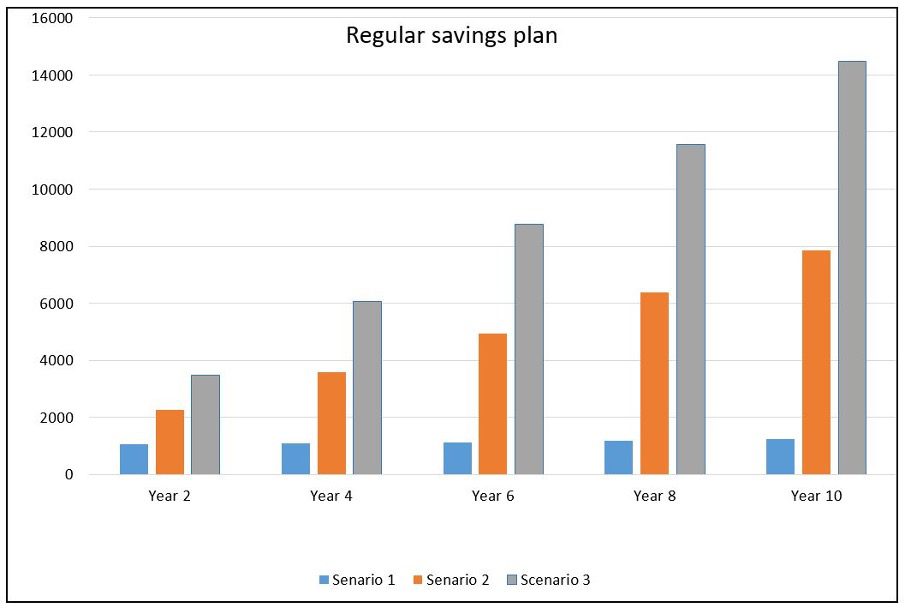
    Each scenario is based on a $1,000 initial deposit with 2% PA interest calculated monthly. In Scenario 1 no further deposits are made. Scenario 2: shows $50 monthly deposits, and Scenario 3: $100 monthly deposits.

    Adjust the figures to suit your personal budget and commit to saving a small amount each pay while still enjoying a life. Have the amount automatically deducted from your account and soon you won’t even miss it!

    Regular savings accounts are available from banks and other financial institutions, and offer a variety of arrangements. For example:

    • Your initial deposit can be as little as $50.
    • Some pay bonus interest if no withdrawals are made in a month.
    • Some offer higher interest for 18 – 24 year olds. 

    Do your research, particularly websites providing independent product comparisons.

    Seek Advice

    A professional financial planner can tailor a plan specifically for you. They will consider your debt, income, goals and much more, and work with you to structure a strategy for now, and into the future – you may even be surprised at how inexpensive good advice can be. 

    So, there you are! The future is laid before you and it’s loaded with potential; all you need to do now is get on with it.


  • Superannuation: Making the Right Choice

    Superannuation: Making the Right Choice

    One of the best things about living in Australia is the high level of choice we have in everything from milk to superannuation funds. For many of us, having a choice of where our super will be held is an important part of our investment management and a decision that should not be made without sufficient research.

    Whether you are changing employment or you’re not happy with the fund your employer offers, below are several key points to consider in selecting a super fund to meet your needs. Also listed are seven actions you can take to help yourself on the path to making the right choice for your future.


    It’s Your super

    There is a range of options available for investing your super – retail funds, industry funds, corporate and public sector funds; or you can choose to manage your own. The choice of fund may depend on your employer or industry. Regardless, this is your money that is being invested for your future use, so it’s crucial that you take a keen interest in your superannuation.

    Action 1 – Ask your employer if you can choose your own super fund.

    Investment options

    Super is a tax-effective way to invest. Your super fund should give choices of investments – after all, one way of investing is unlikely to suit everyone. How much choice you need depends on your personal circumstances such as how much money you have in your fund, your attitude to investing, and how much involvement you wish to have in making investment decisions.

    Does your fund provide suitable options? Are you invested in the most appropriate way? Your choice can make a big difference. There are generally five or six different investment options which can provide you with varying levels of exposure to each asset class. For example, a capital secure fund may invest your money predominantly in bonds and cash or interest rate products. A balanced or diversified fund on the other hand, might invest your money partly in bonds, cash and interest rate products and partly in shares and property.

    Action 2 – Ask your super fund what investment choices they offer.

    Fees

    All super funds will charge fees in some way. The key issue is not the fees but the value provided by the fund. Like all things “you get what you pay for”. Some simple funds are cheaper but may not offer the options and facilities you need. Some funds may be too complicated or expensive for your needs.

    Do you use the facilities offered by your fund? Are you paying for things you don’t need or missing opportunities from a fund that is too basic?

    Action 3 – Ask your super fund what fees they charge.

    Insurance

    If you have insurance cover via your superannuation you probably think you’re adequately covered, yet if something bad were to happen, you might be in for an unpleasant surprise – and by then it might be too late. 

    Many super funds provide a simple, low-cost and tax-effective way to get insurance cover in the event of death or disability but you need to determine if the current level is appropriate to you. And review the cover at each stage of your life.

    Another point to remember is that a portion of your super contributions is used to pay the insurance premiums. This means that you’re not contributing as much as you believe.

    What personal insurance cover do you have now? Is it too much or not enough? Is it better to pay the premiums personally or from your super fund?

    Action 4 – Determine what personal insurance cover you need. Ask your super fund about what insurance is offered and do the sums. Then talk to your financial adviser.

    Range of services

    Super funds have become more competitive and offer a wide range of services to make it easier to keep track of your investment and tailor it to your needs.

    Can you access your account online? How easy is it to make contributions or switch investments? How often does your super fund send you statements, updates or news about your fund? What education services such as seminars, online calculators and guides are available? How easy is it to speak to a human being?

    Action 5 – What other services does your super fund offer?

    More super choices

    Your superannuation needs to provide for your future – the planned and the unexpected. For most people their super will pay an income when they retire as a pension or “retirement income stream”. When you die the super fund will pay out your super to your dependents or your estate. In some funds, you can advise or direct the fund as to how your super is paid out.

    Does the fund allow binding death benefit nominations? Does the fund provide a range of pensions with suitable investment options? 

    Action 6 – What other important choices does your super fund offer?

    Default options

    Super funds have to invest, provide insurance and other services for fund members who make no choice – this is called the “default” option.

    How will your money be invested if you make no choice? What insurance cover will you have?

    Action 7 – If you have “chosen” the default option, will it meet your individual needs?

    As you can see, choosing the right super fund is a major decision. There is a lot to consider. If it all seems too hard, give us a call and we can evaluate your options and help you make the best choice for your specific needs.  

  • Everything You Wanted to Know about Buying a Home

    Everything You Wanted to Know about Buying a Home

    Ready to make the leap from renting to buying a home? Well, before you begin the search for your perfect home there are lots of questions to find answers to. Here are some of the big ones.  

    Do you need to own your home?

    For most people home ownership remains part of the great Australian dream, but that’s changing. Renting offers greater flexibility and can be an economically viable alternative to buying. Weigh up the pros and cons first to see if you really want or need to own your home. 

    If the answer is a definite yes, then…


    What repayments can you afford?

    To answer this question with any certainty you really do need to do a budget. This should show you exactly how much money is coming in, how much is going out, and how much is left to service your mortgage. Your budget will identify what you are spending money on and may reveal areas where you can save more. If your plans include starting a family at some stage, factor in the likely drop in income.

    How much can you borrow?

    Once you know how much you can spend on mortgage repayments you need to work out the size of the mortgage these repayments will support. 

    Plug your repayments into the mortgage calculator at www.moneysmart.gov.au. Use an interest rate of at least 7% per annum. While you may be able to borrow at a much lower rate, and therefore afford a larger mortgage now, banks are required to check that borrowers can comfortably service their loan if there is a significant rise in interest rates. The figure currently set by the government regulator (APRA) is 7%, but some lenders use even higher figures. 

    What’s it really going to cost? 

    Aside from the purchase price, buying a home comes with a whole lot of other costs, some upfront and many ongoing. 

    Stamp (or transfer) duty is usually the biggest of these. Remember to allow for it when setting your purchase limit. Conveyancing, loan establishment fees and removalists are other upfront costs. 

    Buying an apartment or unit? Body corporate fees will need to be paid. These, along with other ongoing costs such as council rates and insurance premiums must be included in your budget. 

    If this purchase will be your first home, check out details on first home buyer grants in your state or territory here www.firsthome.gov.au. Stamp duty concessions may also be available. Combining these initiatives can save you tens of thousands of dollars. Make sure you understand the conditions that apply, such as limits on the value of the property. If eligible for a grant, factor this into your calculations.

    What deposit do you need? 

    While you may still find lenders willing to loan up to 90% of the value of a property, 80% is a more likely and sensible limit. That leaves you to come up with 20% of the purchase price plus upfront costs. 

    Have you saved your deposit, or do you still have some way to go? If the latter, review your budget to see how much you can save. Then set some savings goals and document how you will achieve them.

    What’s your savings record?

    Your lender will want to see your bank account and credit card statements. Do they reveal a good savings history and responsible use of debt; or the habits of a reckless spender with a poor credit rating? If it’s going to take time to save your deposit, it’s not too late to build a good savings history that will impress your lender. 

    Try to clear current debts as quickly as possible. Cancel any unnecessary credit cards, and consider cutting back the spending limit on other cards. When you apply for a mortgage your lender will include your credit card limits, not the actual balances, in their calculation of your current debt.

    Do you know how mortgages and interest rates work?

    If not, start learning from independent sources. 

    Get as much information as possible from the lender, with details of all the fees that apply – including any early repayment charges (yes, you can be charged for paying off your mortgage early!). If the loan comes with any ‘sweeteners’ or other features, make sure you understand them and any potential costs. Understand comparison rates and their limitations.

    Aside from the purchase price, the biggest influence on how much your home will eventually cost you is the interest rate. On a $400,000 mortgage at 4% per annum over 25 years with monthly repayments (and ignoring fees), you’ll end up repaying a total of $633,404 of which $233,404 is interest. At an interest rate of 7% that interest bill rises to $448,135!

    Fixed or variable?

    Your lender may offer you the opportunity to fix the interest rate on at least a portion of your loan for up to five years. A fixed rate will be an advantage if interest rates rise. If they fall, you’ll end up paying more interest than if you opted for a variable rate on the entire loan. Investigate the option of splitting your loan between variable and fixed rates.

    Interest rates tend to rise when the economy is strong, unemployment low and the inflation rate is increasing. They tend to fall when the opposite conditions prevail. That said; it’s extremely difficult to predict future interest rate movements. Should rates fall, you may face significant fees on any early repayment of the fixed component of your mortgage. 

    How can you reduce your interest payments? 

    Your interest is calculated on your outstanding loan balance, so anything you can do to reduce that balance will help reduce your total interest bill. Many loans offer a linked 100% offset account. The balance in your offset account is subtracted from your outstanding loan amount when the interest is being calculated. It therefore makes sense to keep as much of your spare cash as possible in your offset account.   

    As financial circumstances allow, you could increase your mortgage repayments to pay off the loan sooner. Using the previous example of a $400,000 loan at 4% interest, if you paid it off in 20 years rather than 25, the interest component would be only $181,741, a saving of more than $51,000.

    Another option is to make fortnightly or weekly repayments, rather than monthly. 

    Ready to buy? 

    Be aware that it is now more difficult to get a loan due to lender and regulator concerns over high levels of household debt. However, there are still plenty of lenders to choose from, including your current bank, other banks, non-bank and online lenders. It can pay to shop around, whether you do it yourself or use a licensed mortgage broker.

    When it comes to applying for a loan be prepared to provide your lender with a lot of information – pay slips, credit card and bank statements, and details of your assets and any debts you have. Then, before you start visiting open houses, consider seeking pre-approval from your intended lender. Be aware that pre-approval may not guarantee that your loan application will be successful, particularly if it’s an instant appraisal based solely on the information you provide. Check with your lender what their pre-approval actually means. If it’s a full assessment it will provide you with more certainty when making an offer. Even then, pre-approval may not protect you if, say, the property is unacceptable to the lender. Also be aware that making multiple pre-assessment applications can affect your credit rating.

    Do you understand everything, including all the fine print?

    If not, ask questions and seek independent advice. Never, ever, sign a blank form. Make the right decision the first time as the costs of switching lenders can be high. 

    What insurance cover do you need? 

    You’ll obviously insure the house and contents, but what other insurance cover do you need? With your ability to make mortgage repayments dependent on you earning an income, income protection insurance should be a high priority. Life and disability insurance should also be considered. And yes, these premiums all need to be included in your budget calculations.

    Need advice? 

    Buying a home is one of the biggest financial steps you’ll ever take. It’s also a complex process, and seeking good financial advice at the outset can deliver rewards down the track.

    When the ink is dry it’s time to crack open that bottle of bubbly and celebrate getting your foot in the door of home ownership.    

  • 5 Simple Techniques to Reduce Your Tax

    5 Simple Techniques to Reduce Your Tax

    His words might have been recorded over 200 years ago, but Benjamin Franklin’s famous uttering “in this world nothing can be said to be certain, except death and taxes” remains as true today as it was in 1789. The one thing that has constantly changed is tax law, and although death is impossible to avoid, with the many options available to us, taxation doesn’t need to inflict too much pain. 


    Here is a list of tips to help you minimise the amount of tax you pay.

    1. Keep Records

    Even if you use an accountant to prepare your tax return, you are responsible for the information you provide and for keeping your tax records for a minimum of five years. So, to ensure that you don’t have to pay any more tax than you are obliged to: 

    • Keep receipts of all your tax-deductible expenditure. If you are audited by the tax office, you will need to be able to prove the expenses were incurred. When you claim a tax deduction for something, you obtain a tax benefit equal to the amount of tax you would have paid on that income at your tax rate. For example, if you are on the current top marginal tax rate of 47%[1], claiming a $100 tax deduction will produce a tax benefit of $47.
    • Keep track of all your medical expenses. If net medical expenses relating to disability aids, attendant care or aged care exceed the threshold for the year, you may be eligible for a tax offset that takes the form of a credit against tax payable. For example, if you are entitled to a $100 tax offset, your total tax bill will be reduced by $100. 
    • Keep detailed records of income and capital gains. Required details include date the investment was purchased, how much was paid, when it was sold and how much was received. Other details may include the costs of improvements to an investment property as well as the amount of income received over the timeframe the investment was held. 

    2. Claim All Available tax Deductions

    You may be able to claim a tax deduction for many of your expenses. These include:

    • donations to registered charities or non-profit organisations;
    • self-education expenses;
    • premiums on income protection insurance;
    • work-related expenses.

    You should bear in mind that the range of permissible work-related expenses varies widely from occupation to occupation. Refer to the Australian Tax Office (ATO) website www.ato.gov.au for full details. 

    3. Consider Salary Packaging

    Salary packaging involves the receipt of certain non-cash benefits in place of a taxable salary.

    Fringe Benefits Tax (FBT) means that most non-cash benefits are taxed at the highest marginal tax rate. Receiving these benefits does not improve your taxation position, and if you are a low-income earner it may actually increase the tax you have to pay.

    However, some items receive favourable treatment under FBT rules, so it can still be an advantage to consider these benefits as part of a salary package. 

    Beneficial salary packaging arrangements may include mobile phones, laptop computers, and novated leases on motor vehicles. 

    Not everyone can obtain a real benefit from salary packaging. There are also some paperwork and procedural requirements that need to be fulfilled to set up an effective salary packaging arrangement, so talk to a professional adviser before embarking on this strategy. 

    4. Contribute to Superannuation

    Contributions to superannuation can reduce the level of tax you would otherwise have to pay on your investments because super is taxed at a maximum of 15%. In addition, some people are eligible to claim a tax deduction for contributions made to super.

    The rules surrounding superannuation tax deductibility provisions and contribution limits are complex, so it pays to seek advice from your financial planner.

    5. Manage Capital Gains

    When you sell an investment for a profit, you are considered to have made a capital gain. For non-professional investors, capital gains will be included on your annual income tax return. Assets acquired before 20 September 1985 are exempt from Capital Gains Tax (CGT) considerations.

    When you sell an asset for less than you initially paid for it, you make a capital loss. When your total capital losses for the year outweigh your total capital gains, you will finish up with a net capital loss for the year.

    If you have a potential CGT liability, there are a few strategies that you could consider to reduce the amount you need to pay.

    • Keep an investment for at least 12 months

    Investors are entitled to claim a 50% discount on capital gains made on assets held for longer than a year. So, by holding on to the investment for more than 12 months you will halve the CGT payable.

    • Delay any gains until the new financial year

    If you are thinking of selling a profitable asset, such as shares or property, it may be worth deferring this sale until after the end of the financial year. By doing so, you will delay incurring CGT for another financial year. While you will need to pay the CGT eventually, freeing up short-term cash flow may be beneficial, depending on your circumstances.

    • Use carry-forward tax losses to reduce CGT

    Capital losses incurred in previous tax years that have not already been offset against capital gains may be carried forward in future tax years and can mitigate the effect of any CGT liability. Check your past income tax returns or ask your accountant to determine whether this is an option for you. 

    Remember that this information is not personal tax advice. Always consult a professional adviser to help you determine the best strategies for your personal circumstances.   

  • Hitting an Insurance Home Run

    Hitting an Insurance Home Run

    Most people either cringe or yawn when the word insurance is mentioned but regardless of whether you find it scary or boring, managing risk is a necessity in the world in which we now live. Let’s cover all of the bases to help make your home run as easy as possible.

    First Base – Income Protection

    Considering that over 114,000 people in Australia made a workers’ compensation claim in 2018/19, what would your future look like if suddenly you were unable to work? 

    For most of us, the ability to earn an income is our most valuable asset. Depending on your age, your future income may well be worth far more than a house and its contents, a couple of cars, a boat or caravan all combined. Yet few people properly insure their income, and if illness or injury prevents them from working, financial hardship often results. With around half of us likely to spend more than three months off work due to ill health during our working lives, Income Protection insurance should be the first item on the personal insurance list. 

    Income Protection or Salary Continuance insurance can pay you a regular amount, usually up to 75% of your normal income if you are unable to work due to illness or injury. Benefits are taxable, and commence after a waiting period. Payments continue to be made until you return to work or until the benefit period expires. The waiting period and the benefit period are selected at the time of application. 


    Second Base – Life & Permanent Disability 

    Life Insurance pays a lump sum benefit if the policyholder dies. But what happens if they don’t die and can never return to work in their chosen occupation? Total and Permanent Disability (TPD) insurance can help ease the financial burden caused by loss of income by providing a lump sum payment.

    Most people underestimate the level of life insurance they need. The insured sum should be enough to clear net debt, cover future expenses such as school fees, and provide an adequate replacement for the income that the deceased would have earned through to their normal retirement age. For a breadwinner with young children, an appropriate amount may be well in excess of $1 million. This cover is also important for primary care givers to ensure the children are properly cared for.

    Third Base – Trauma Cover 

    Trauma Insurance fills a gap between Income Protection, Life and TPD Insurance. It was designed by a doctor who found that his patients’ recoveries were hampered by their concerns over the financial burden caused by major illness. Trauma Insurance pays a lump sum benefit on the occurrence of a specified condition such as cancer, heart attack or stroke, which can strike at any age. It often provides a benefit when neither Income Protection nor TPD Insurance claims can be made.

    Unlike Income Protection, where the benefit is paid if you are unable to work regardless of the nature of the illness, trauma payments are based upon the specific illness, not the degree of disability. 

    Trauma Insurance is designed to cover out-of-pocket medical expenses and other costs associated with major illness, and to allow recovery to take place without financial worry. It isn’t a replacement for the other types of personal insurance. A comprehensive insurance portfolio will include Life, TPD, Income Protection and Trauma Insurance. 

    Home Base – General Insurance

    Most people insure their house and contents, motor vehicles and other possessions. The key here is to make sure that all possessions are covered for full replacement value. Insurance companies provide guides on their websites to determine an appropriate level of cover. Don’t forget valuables like jewellery, antiques or artwork, which often have to be separately noted in the cover. 

    A Super Way to Insure

    Most superannuation funds (and all industry funds) offer Life and Permanent Disability Insurance. 

    There are a number of advantages in holding life insurance inside your super fund. 

    Super funds can often negotiate wholesale insurance rates, so premiums for their life insurance are often lower than can otherwise be obtained as an individual. In addition, premiums are paid from your superannuation balance. Whilst this reduces your ultimate retirement benefit, the relative effect is usually small, and by relieving the strain on the household budget, you may be able to increase your overall savings. The main advantage of insurance held in super is that the premiums are tax-deductible to the fund, which ultimately reduces your cost of insurance.

    When you join a superannuation fund you may be offered a minimum level of insurance. This is rarely enough to provide adequate cover and it’s up to you to request an appropriate level. Depending on your age, medical history and the level of cover you require, you may also need to undergo a medical examination

    When leaving a superannuation fund you should find out what happens to your insurance cover. You may be offered a “continuation option”, which is an ongoing policy provided by the insurance company. If you don’t take this up within the period that the offer covers, you may find yourself without insurance. If this happens, and if there has been a change in your health, it may be difficult and cost much more to obtain replacement cover in the future. 

    From 1 July 2019, to ensure that super balances aren’t unnecessarily eroded by insurance premiums, if your superannuation account receives no contributions for 16 consecutive months, it is deemed to be inactive and any insurance held in the fund will be cancelled unless you notify the fund that you wish to retain the insurance.

    Find a Coach

    Insurance is a complex area. Policies vary in their detail and insurance companies differ in their approach to processing both applications and claims. 

    Each type of insurance has a role to play and it is a job for an expert to work out the right amount of each type for you. You should also seek expert advice whenever you consider allowing a policy to lapse to ensure you are fully aware of the potential consequences. 

    We can analyse your insurance needs and recommend cover that’s right for you and your budget. After all, you don’t want to strike out before reaching first base. 


  • Investing in Overseas Shares

    Investing in Overseas Shares

    Like the idea of owning your own small part of some of the world’s largest and fastest growing companies? Maybe you want to tap into the growth potential of emerging economies, or get in early on the next big thing in technology. To achieve these investment goals you’ll need to look beyond Australia’s shores to access a wide range of investment opportunities that are simply not available on the local market. 

    Why Invest in Overseas Shares?

    While we have our local success stories, we don’t really have the equivalent of the FAANGs (Facebook, Apple, Amazon, Netflix and Google) that have generated much of the growth in the US markets. Nor do we have a local Toyota or Tesla, Nike or Boeing. Tapping into the growth potential of these companies requires investment in overseas shares. The New York Stock Exchange alone is around 20 times bigger than the Australian Stock Exchange. That means more companies engaged in a wider range of businesses offering a bigger universe of opportunities. 

    Then there are emerging markets. China and India are two large economies that have grown rapidly for a number of years, and buying the right shares in these markets allows investors to access this growth. 

    Because different economies, sectors, technologies and geographies perform differently at different times, investing in a range of international shares provides a diversification benefit that, over the medium to long term, helps to reduce investment risk while maintaining returns.


    How to Invest in Overseas Shares

    There are two main ways to invest in overseas shares:

    Direct Share Purchase. Most stockbrokers offer clients the opportunity to buy international shares, though they may only provide access to a limited number of markets. Also, an international custodian may legally hold the shares, although you’ll have the right of beneficial ownership. 

    Managed Funds. Investors can choose from a wide range of funds that provide exposure to many different markets (regional or country-specific), technologies (biotech, lithium, cleantech, resources), or management styles (high dividend funds versus growth funds). At the fund level, a professional manager makes investment decisions, relieving investors of this crucial task. 

    Managed funds may be unlisted, in which case units are bought from and redeemed with the manager. There are also exchange-traded funds (ETFs), where units are bought and sold on the Australian share market in much the same way as direct shares. ETFs usually track a specific index, and this ‘passive’ approach means they often charge lower fees than actively managed unlisted funds. As ETFs can be bought and sold whenever the market is trading, they provide quicker entry and exit from your investment than is the case with unlisted funds. 

    Currency Concerns

    When you invest in international shares you are effectively investing in two asset classes – the shares themselves and the currency of your overseas investment. In fact, there may be periods when currency movements have a greater impact on your investment performance than any changes in the underlying share price. 

    Given a steady share price, if the Australian dollar falls in value against the currency your investment is held in, then the value of your investment in Australian dollars will increase. However, if the investment’s currency falls against the Australian dollar, then the value of your holding in Australian dollars will also fall. 

    Some managed funds use hedging to provide protection against changes in exchange rates. This means the value of your holding in Australian dollars should primarily be determined by investment performance, not currency movements. However, hedging comes at a cost, so while it may decrease risk, the extra cost may also decrease net returns. 

    Create a Plan

    Whether you opt for managed funds, direct investment or a bit of both, it’s important to understand exactly what you are investing in. When buying shares directly, specific company research may be harder to come by, particularly for smaller companies and emerging markets. This leads to higher risk. With managed funds you need to understand the manager’s style, focus (large companies, small companies, specific technologies or other themes), and whether currency exposure is hedged. 

    You also need to understand how dividends and capital gains are taxed. This varies from country to country, and you may need to complete some paperwork to reap the benefits of Australia’s tax treaties with other countries, and not pay any more tax than you need to. 

    Remember that international shares should only form part of a well-diversified portfolio. And as one of the more volatile (i.e. higher risk) assets, expect values to fall occasionally as well as rise. Put together an investment plan detailing what you want to invest in, how, and how much. By all means undertake your own research, but talk with your stockbroker or financial planner, too. 

    Embrace the Opportunity 

    Whether it’s through direct shares or managed funds there’s a place for international shares in most portfolios, and it’s never been easier to grab yourself a piece of iconic brands such as Apple and Facebook. If you want to own a piece of the big end of town, dabble in niche markets or buy into tomorrow’s world-changing technologies, opportunity awaits. If you take advice and follow the rules of sensible investing, it could be a very lucrative move indeed.    


  • Tap into the Amazing Power of Compounding

    Tap into the Amazing Power of Compounding

    When you invest over a period of time, compound interest is your best friend. In effect, it means you are earning interest not just on your own capital, but also on the interest you’ve already earned. Over the long term, this might be phrased as “interest on interest on interest on interest on interest …” or more simply, “free money”! So how do you get this free money? This is how… 

    A Simple Start

    Imagine you place $100 in an investment that earns 10% pa. At the end of one year, you’ve earned $10. Then you spend all the interest you receive. At the end of each year, your investment amount is back to $100. That’s simple interest. At the end of 10 years, you will still have your $100, and you will have received a total of $100 in interest. 


    I = P(1+r)n-P

    Don’t worry, we’ll do the maths for you, but this little formula contains a power that Albert Einstein is attributed to labelling “the most powerful force in the universe”. It calculates your net profit when you earn interest on the interest. That’s what compounding is all about. 

    Going back to our first example – if you re-invest the interest on your original $100, at the end of the first year you will have $110. Leaving it invested at 10% pa, you will earn interest of $11 in the second year, bringing the total in the account to $121. If you keep going for 10 years, your investment will grow to $270.70 – that’s your original $100 plus $170.70 in interest. 

    Time is Money – Literally

    This example may not seem so impressive, but the power of compound interest really shines over the long term. Looking at our simple situation and taking the interest out each year for 30 years, you will earn a total of $300 in interest. But relying only on the compounding of the interest (ie. no other deposits are made), the total interest earned over the same time would be $1,883.74.

    A child born today could easily live to 100. Simple interest on a $100 investment would amount to $1,000 over their lifetime. Left to compound untouched at 10%, that same investment would grow to $2,113,241! Even on such a small initial investment, that’s an incredible difference!

    The other critical factor is the actual rate of earnings. If the earnings rate dropped just 1% to 9% pa, a one-hundred-year investment would grow to only $783,548

    A Couple of Drags

    But don’t forget to take into account tax and inflation. They act as drags on investment performance. 

    Let’s assume investment earnings remain at 10% pa and are fully taxable. What will your $100 grow to over 30 years at different tax rates?

    0% Tax(Allocated Pension)15% Tax(Super Fund)34.5% Tax(Average Taxpayer)47% Tax(Top Tax Rate)
    $1,983.74$1,269.25$709.69$488.66

    Note: Includes 2% Medicare Levy.

    As for inflation, although we are currently experiencing very low inflation, nobody knows how long this will last. If it reaches the Reserve Bank’s target of 3%pa, you will need $2.43 in 30 years’ time to buy something that costs $1.00 today.

    There are many ways of minimising the effects of tax and inflation. Picking the right tax environment is clearly important. Capital gains are only taxed when an investment is sold, so growth assets have an advantage over those that only produce income. They also cope better with inflation. 

    Investment Risk

    Always remember, seeking higher returns generally involves taking higher risks but some of those risks can be managed with an effective and professionally constructed investment strategy. 

    If you want to take advantage of “the most powerful force in the universe”, talk to your licensed financial adviser.   


  • When was the Last Time You Paid Cash for Something?

    When was the Last Time You Paid Cash for Something?

    Prior to COVID, we were steadily moving towards a cashless world. Post 2020, even the most resilient of us has made the leap to tap-and-go payments sooner than we expected.

    From the morning coffee to filling up the petrol tank, we wave that plastic with little thought to the impact on our account balances.

    In fairness to us, many retailers are now adopting the ‘no-cash, please’ trading regime, but we Australians have a reputation for embracing technology and touchless shopping is no exception.

    According to the Organisation for Economic Co-operation and Development (OECD), Australian household debt is currently sitting at around 210% of net disposable income. That places us fifth in the world, behind Denmark (257%), Norway (240%), Netherlands (236%) and Switzerland (223%).

    Compared with countries with spending habits similar to our own – the USA with (105%) and the UK (142%) – we’re quite high.

    If your debt level is pushing northwards of your preferred limit, here are a few ideas for getting – and staying – on track:

    • Pay your full card balance off every month. Sure, it’s an oldie but a goodie. You know what you need to do; if your current balance is too high, pay more than the minimum amount. The first step in breaking the credit cycle is to get off it, which leads into our next point:
    • Create a realistic budget so you can identify where your money is going and how much extra you can pay off your credit cards. The government’s Moneysmart website has a free budget planner to help you. Alternatively, chat with your financial planner and work with them to develop a payment strategy to get your debts under control, and stay that way.
    • Keep your tap-and-go receipts and reconcile them against your account each week. This is one of the best ways to see exactly how much you’re shelling out, and on what. You’ll identify areas of unnecessary spending, and you’ll spot any errors or dodgy transactions. 
    • Instead of a credit card for your touchless transactions, consider using a pre-paid card. Available from banks and other financial institutions – even Australia Post offers one – you load it with your own money and use it for in-person or online shopping. It’s just like a credit card but without the risk of getting into debt. 
    • Consider your subscriptions, you know, streaming services, magazines and memberships, etc.. Many renew automatically and the first you’ll know about it is an unexpected – often expensive – transaction on your card. Do a stocktake to see what subscriptions you have and decide if you really need them. For those you no longer need, change your subscription settings so they don’t automatically renew. Don’t worry, they’ll alert you when the renewal is due in case you change your mind!

    We’re definitely living in an interesting time. Our lives have altered in ways we’d never have imagined and we Australians, in our typical way, are adapting to these ‘new-norms’. 

    This is a good thing, just as long as we stay in control!


  • Superannuation and New Cars are Very Similar

    Superannuation and New Cars are Very Similar

    Superannuation can be one of the most baffling topics when it comes to managing our finances so let’s relate looking for the right fund to something that might be more enjoyable – buying a new car. What do you look for?

    Size and Speed

    The engine of growth in super is the investments you choose. At one extreme, you can select “vintage” investments that will be slow and steady. At the other extreme, you can choose supercharged V8 investments to take you faster (but sometimes give you a few hairy moments going around corners!).

    If you’re young, high-speed investments might be appealing. For the more mature, “steady as she goes” might be the way to travel. You can have a super fund where you do everything yourself or you can leave the maintenance to the professionals.

    Safety Features

    Whilst you want your car to “go” you also want it to stop and be safe. You will want good brakes and seat belts and air bags. There are some risks you can never completely avoid in your car such as the actions of other drivers.

    With super, you might reduce the risks by diversifying your investments or arranging life insurance in your super fund. Insurance can be for a basic amount or can be increased to cover all of your needs. There are some types of insurance that cannot be placed in your super fund such as trauma cover and health insurance.

    Trusted Name

    Many people look for a well-known name when buying a car. There is a feeling of safety buying from an established dealer because they have their reputation to consider if things go wrong.

    With super, you want this same degree of safety knowing a reliable and established organisation is behind the fund. You want it to be managed well and to comply with all of the rules and regulations. You expect consistent and trustworthy administration and for the manager to continually improve their services. You want the key people in the organisation to make wise decisions about your investments.

    Education

    The more sophisticated your new car the more assistance you need to ensure you use it properly. Many motorists seldom read the handbook until something goes wrong. If you are buying a 4WD you may look for driving courses, booklets and videos explaining how the vehicle operates compared to a normal car. 

    In a super fund, you may expect nothing more than an annual report and personal statement telling you how much you have accumulated. On the other hand, you may value newsletters, educational seminars and online access to your account. You may prefer to use a financial planner to help customise the fund to your needs.

    Price

    When buying a car, you might decide to trade in your old model or sell it privately for a better price. You will be concerned about how much you will have to outlay to drive your new car away. But it doesn’t stop there. Once you are driving, you need to consider fuel consumption, spare parts and maintenance costs. The costs will depend on how you drive and how you use your vehicle.

    For super, there are the same complexities to consider. The running costs will depend on how you use the fund – more complex investment options and more insurance will increase costs, whilst staying with standard options will be cheaper but may not meet your needs.

    Optional Extras

    Many vehicles now include standard features that were once optional extras, but you can still choose colours and accessories such as a tow bar, roof racks and so on.

    Super is the same. For instance, you may be able to nominate who gets your super when you die. Membership of some funds may qualify you for special deals like access to home loans or discount travel.

    While you may only be concerned with accumulating money in super now, in the future you will want to access it. This could be in the form of lump sum or pension withdrawals. The nearer you are to retirement, the more important it is to select a fund that will serve you well when you start to draw an income.

    Making the Change

    Buying a new car is not something most of us do every day and it should be the same with changing super funds. It is a human foible that we tend to focus on short-term issues rather than the more important long-term outcomes. Buying a car is much more exciting and immediately rewarding than planning for your future. 

    Super choice provides an incentive to consider all of your financial needs and ensure your fund is working for you. And finally, you wouldn’t buy your new car from a dodgy dealer, so don’t rely on any old advice on your super. Always consult a professional financial adviser who specialises in this area.    


  • Property Investing and SMSFs – the Differences

    Property Investing and SMSFs – the Differences

    Australians love to invest in property. And what’s not to love? It’s tangible, offers diversification and tax benefits, and can provide you with a good income and strong capital growth. 

    The benefits of investing in property can be amplified when held within super and with changes to borrowing within Self-Managed Super Funds (SMSFs) over the past few years, the ability to access property investment through super has widened significantly. This strategy however, is not for everyone. 

    Investing in property within a SMSF is not a straightforward proposition. It is a highly regulated affair and having an understanding of the rules is essential to ensure your fund remains compliant and you don’t get caught out in a compromising and costly position.

    What Type of Property Can be Purchased within a SMSF?

    You can purchase all kinds of property within your SMSF – commercial, industrial or residential. But there are different regulatory requirements for each.

    Residential Property

    Any residential property you wish to purchase through your SMSF must:

    • meet the ‘sole purpose test’ – this essentially means the fund must be run for the sole purpose of providing retirement benefits to its members;
    • not be attained from a related party to the member such as a spouse, family member or business partner;
    • not be rented or lived in by a member or party related to the member.

    Commercial or Industrial Property (Business Real Property) 

    Similar to investing in residential property, any commercial or industrial property investment must also meet the sole purpose test. Except that you can rent or purchase commercial or industrial property (business real property) from your SMSF – provided it’s at market rates. 

    When a SMSF Can Borrow

    In the event that you have insufficient capital within your SMSF to purchase the property outright, your Fund can borrow to purchase property through the use of a limited recourse borrowing arrangement.

    Be aware that borrowing arrangements through super can be very restrictive. There are rules around acquiring property using borrowings. For example, although a SMSF can purchase a vacant block of land, it cannot purchase a block of land with the view of constructing a house on the block using borrowings. This would breach the ‘single acquirable asset rule’. 

    Under this rule, a house and land package would generally not be treated as a single acquirable asset unless there are only two payments involved, e.g. a 30% deposit and a 70% payment of the balance when the house is complete.

    You should be cautious when it comes to investing in property through your SMSF. There are many property “specialists” who have a vested interest in selling these kinds of investments to SMSF members. They are likely to receive some sort of commission and may push property purchases through super without having an accurate understanding of a member’s situation.

    Investing in property through super is not advisable for everyone. Before signing any type of contract always seek advice from a licensed financial planner or authorised SMSF specialist.